Fare evasion: MTA honcho says pilot of ‘European’ enforcement model now focused on express buses

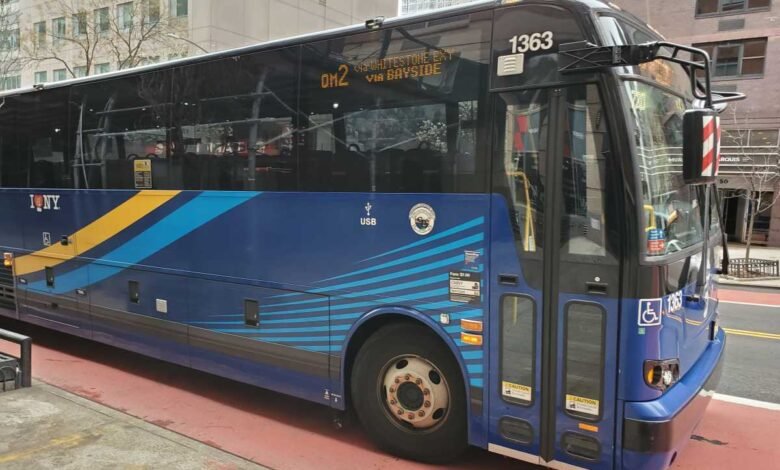
A top MTA official said on Wednesday that the agency has shifted in its approach to piloting a new “European model” for enforcing against bus fare evasion — now testing devices to validate electronic payments mostly on express rather than local bus routes.
The official, New York City Transit President Demetrius Crichlow, made the revelation during a news conference following this month’s MTA board meeting.
Crichlow’s remarks came after his April announcement that the agency’s bus fare enforcement squads, known as Evasion And Graffiti Lawlessness Eradication (EAGLE) Teams, had begun using handheld technology to check if riders paid for their trips via the OMNY tap-and-pay system on local buses.
Fare enforcement agents can use the “Onboard Validation Devices,” which resemble smartphones, to scan riders’ OMNY cards, credit/debit cards, or phones to verify if they paid, and issue tickets to those found to have skipped the fare.
Previously, EAGLE Teams had used the devices only on select bus service (SBS) routes.
Crichlow said the agency has transitioned to mainly testing the practice on express routes, which feature coach buses that run between boroughs during peak weekday times, over local buses, which account for most of the system, for two reasons.
“We are transitioning or ramping up a lot of the service on the express bus lines,” Crichlow said. “We’ve been focusing a lot of efforts there for a couple of different reasons. One, people kind of expect to get checked on the express lines. But also, it allows us to train our folks on a new technology. And it allows us to be able to ramp things up before we go back to a more heavy presence on the local lines.”

MTA Chair and CEO Janno Lieber, during the same press event, said the pilot currently faces a couple of limitations: the availability of the technology and whether they have enough EAGLE Team personnel.
“We’re still in the pilot stage because we don’t have an unlimited number of handheld devices and people,” Lieber said.
The transit boss began speaking about the enforcement model, a reference to how many cities in Europe enforce against fare evasion on buses, late last year.
The MTA’s embrace of the new model to combat rampant fare evasion on its buses was made possible by its nearly complete transition from the MetroCard to OMNY. The agency ceased selling MetroCards at the end of last year, and while it still accepts them, along with coin payments on buses, it plans to completely shift to tap-and-pay soon.
“The ultimate test will be when we turn off MetroCard once and for all and coin on bus, and then you can really have confidence that everybody who got on the bus ought to have been paid in a way that can be validated through the handheld device,” Lieber said.
Last month, Crichlow said the MTA is also looking at testing the fare enforcement method both while buses are stopped, as EAGLE teams have traditionally operated, and while they are moving.
The MTA says that fare evasion is a particularly persistent problem on its buses, as riders wishing not to pay can simply walk past the driver without tapping or boarding through the back doors while other riders are getting off.
The agency lost $568 million in unpaid bus fares last year, according to a September report from the Citizens Budget Commission watchdog group. Similarly, a December MTA report on fare evasion found the agency lost $315 million in bus payments in 2022.