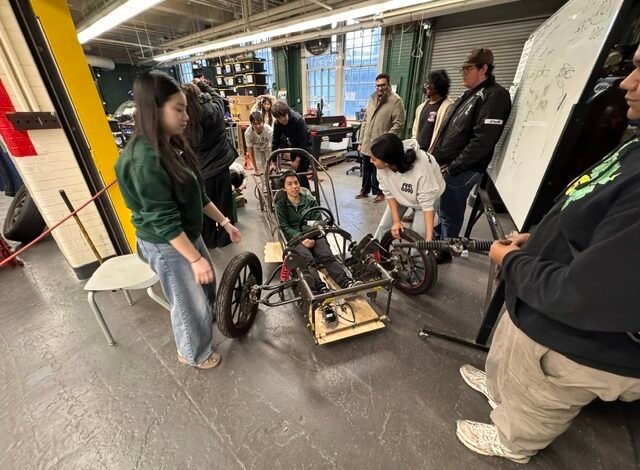
A group of teachers and high-school students from Staten Island is part of an innovative, eco-friendly driving-technology program called Solar Car.
Scholars and students at Ralph R. McKee High School and Staten Island Technical High School put their interest in sustainability into motion as members of the solar car team, Seagull Solar, named after the sister schools’ mascot. They will be participating in a nationwide solar car competition in Texas this summer.
As Seagull Solar team members, students do real hands-on engineering work to build a solar car, which is a three-wheeled vehicle with two wheels in the front and one in the back on a custom-built swing arm. Under their teachers’ guidance, the young students do most of the work to create the eco-conscious car.

“This isn’t a simulation,” teacher TJ Smolka said. “It’s the most authentic STEM challenge we have ever seen. They’re building an actual race vehicle from the ground up.”
Building a solar-powered car may not be easy, but it includes a lot of hands-on work that fosters the students’ passion for both engineering and sustainability. The program brings together teamwork and green technology in both the classroom and the garage.
McKee students handle most of the fabrication and primary structure during the week, working in the McKee shop. Staten Island Tech students lead the programming and high-voltage electrical systems. The two groups come together every Wednesday evening and Saturday morning for integration work, which includes connecting systems, testing and watching the car move, Smolka explained.
“The work doesn’t stay in the garage,” he said. “Equipment, tools, and training opportunities flow directly into the classrooms at both schools, giving a wider population of students exposure to the same technologies the race team is using.”

Building a solar car takes a lightweight frame, a motor, batteries, solar panels and a protective outer shell. The solar panels capture energy from the sun to charge the batteries, which power the motor that moves the car.
Students also build parts themselves, including pieces of the frame and steering system, before assembling the vehicle and testing it on the road.
The team will even compete in this year’s Solar Car Challenge at Texas Motor Speedway near Dallas-Fort Worth. The road race includes around 700 miles within Texas on July 15.
Smolka explained how the race works.
“The race strategy is as much energy management as it is driving,” he said. “The goal is to sustain 45 mph on solar power alone, reserving battery power only for strategic moments — passing competitors or navigating difficult terrain. Teams start with a fully charged pack and manage every watt-hour precisely, ideally expending the last of their reserves right at the finish line.”
Seagull Solar, which officially launched in 2025, traces its beginning to a collaboration between educators Smolka and Everton Henriques, who first worked together on a high-altitude weather balloon project in 2018. The following summer, they joined the Solar Car Challenge, placing second nationally in their first race after driving from New York to California and back.
When long-time solar car educator Charles Dazzo retired during the 2024—2025 school year, he gave an unfinished vehicle and trailer to the teachers. Rather than continue the original nonprofit, Henriques and Smolka formed a new 501(c)(3) under the name Seagul Solar.

For many students, the program has become more than just an after-school activity. It helps prepare them for possible careers in the automotive, electrical and aerospace industries.
“The team’s philosophy is that they want to do meaningful, ambitious science with kids who need it most,” Smolka said. “The car is the vehicle, literally and figuratively, for teaching real engineering, real problem-solving, and real professional skills. Sustainability is the context. Empowerment is the goal.”
The team’s success relies on donations that support the program and its main goal of addressing climate change and environmental sustainability.
“The team had a very successful fundraising year but is still seeking donations to support the Texas trip — every contribution helps ensure that every student who earned a spot on the roster can make the journey,” Smolka said.
New Yorkers interested in learning more about the program and how to support it can visit statenislandsolarcar.com.