NY’s highest court upholds age cap for judges while cautioning against age discrimination


The state’s highest court upheld on Thursday New York’s mandatory judicial retirement age of 70, but said its ruling should not indicate that age discrimination is generally permissible.
Court of Appeals judges said they were unconvinced by the argument raised by three judges on the cusp of reaching the longstanding state-mandated judicial retirement age. The near-retiring and retired judges had argued that New York state’s Equal Rights Amendment — a 2024 alteration to the state’s Constitution prohibiting discrimination on the basis of a range of protected classes like sex, ethnicity, sexual orientation and age — had made the judicial age cap unconstitutional.
But the high court’s judges said their June 18 decision shouldn’t be interpreted as them saying the ERA is unenforceable. They said they disagreed with the elderly judges’ argument because the judicial age cap is also a constitutional provision, and as such, one part of the Constitution cannot implicitly invalidate another.
“Even where two constitutional provisions are in tension, a new amendment will not implicitly repeal a preexisting provision unless ‘the fact of its opposition to [the] former provision and the intent to displace it by the amendment adopted, [is] so plainly shown by the provisions themselves that there can be no rational doubt in regard to it,” wrote the court’s majority, made up of Associate Judges Jenny Rivera, Michael Garcia, Anthony Cannataro and Caitlin Halligan.
Additionally, the high court ruled, it was clearly not the state legislature’s intent to eradicate the judicial retirement age when passing the ERA to protect New Yorkers’ right to abortion in the wake of the U.S. Supreme Court overturning Roe v. Wade and attacks on the LGBTQ+ community.
Said another way, the court did not think the judicial age cap should be overturned — but it believed claims brought over age discrimination under the ERA generally, like at another job that doesn’t have a Constitutional provision written about, would likely be successful.
Moreover, the court indicated that the ERA should be seen as generally enforceable when a person brings discrimination claims under it, such as those over sex, sexual orientation, ethnicity or other protected classes.
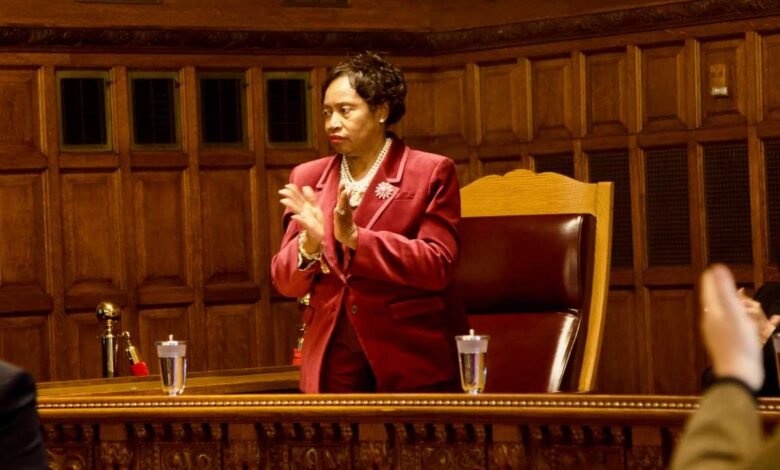
Court of Appeals Associate Justice Shirley Troutman doubled down on that in her concurring opinion, which agreed that the judicial age cap should stand, but chided the majority for not going as far as she did in emphasizing the ERA’s general enforceability, an important distinction since this is the first time the state’s high court is considering a case surrounding it since it passed in 2024.
“The clear intent behind the ERA was to create new rights and to make the Civil Rights Clause self-executing against the government,” Troutman wrote. “The majority does the ERA a disservice by not pronouncing the enforceability of those rights and by concluding blithely that the ERA’s protection of age as a suspect classification does not conflict with a previously existing provision in our Constitution mandating that certain judges and justices retire at age 70,”
New York’s judicial age cap has existed since 1777 and has been set at 70 since 1896, though a 1961 provision permits certain situations in which a judge may serve until 76. Voters overwhelmingly elected not to raise the cap to 80 in 2013, something the state’s high court also noted as a contributing factor in its decision.
“The voters have spoken clearly since 1777 that judges may serve until they reach the constitutional age of retirement. That age limit has never been eliminated,” the majority wrote. “The retirement age is part of New York’s constitutional design. The State’s voters, Legislature, members of the bench, and judicial candidates have understood that judicial service is limited in this specific way.”
John Leventhal, the attorney representing the retired and current judges who brought the case – Robert J. Miller, 76, Richard J. Montelione, 70, and Orlando Marrazzo, 76 – said he and his clients were “disappointed” by the ruling.
He said he believed a new Constitutional provision should override an older one, but “respected” the high court and its decision, adding that he was glad that Troutman’s concurring opinion spoke so strongly of the ERA’s enforceability.
The New York Civil Liberties Union, which was not a party to the case but filed a brief on the importance of ERA’s enforceability, didn’t take a position on whether or not judges should have a state-mandated age cap, but also said it was glad the state’s high court indicated the ERA is generally enforceable.
“What is most notable about this decision is that, even though it is somewhat limited and just holds that the mandatory retirement age constitutional provision can’t be invalidated by the ERA, the Court of Appeals included language in this decision indicating pretty clearly that the ERA is enforceable in court,” NYCLU attorney JP Perry said.
She added that the court noted the ERA’s purpose was to expand the list of protected classes in the New York Constitution, which she considered a “big win” for the amendment and for marginalized New Yorkers.
“They are pretty clearly indicating that the ERA does create expansive anti-discrimination equality protections for New Yorkers, and it was meant to be enforceable,” she said. “Even though the decision doesn’t go beyond that, it certainly includes language that should guide lower courts when they are reviewing and interpreting ERA claims as they make their way back up to the Court of Appeals.”
The question of age restrictions as age discrimination is a legally thorny one – take age restrictions that hold a person must be 16 to drive or 21 to drink, for example. And, since the ERA’s passage in 2024, Perry said the majority of suits brought under it have related to age.
Thursday’s limited decision on what the Equal Rights Amendment does and doesn’t do means that questions of age discrimination will likely continue to be means-tested by courts one-by-one until judges come up with a general rule to follow.
“Eventually, the court will reach a decision on what the standard review of how courts should approach age-based classifications is,” Perry said. “But, exactly how courts should do that is still an open question.