“They killed another guy,” someone announced, in my group chat. That message was followed quickly by a link to a video, shot from behind a pane of glass, level with the street. Sadly, you’ve probably seen that video by now: ICE and Border Patrol agents in Minneapolis surround a slim young man squirming helplessly on the ground. Then, suddenly, the indifferent crack of a gunshot. The man’s body goes limp and falls to the ground. Someone near the camera starts to shout. “What the fuck,” the voice says. “They killed—did they fucking kill that guy? Are you fucking kidding me, dude? Not again! Are you fucking kidding me? That guy’s dead.”
“That guy” was Alex Pretti, a thirty-seven-year-old I.C.U. nurse serving in the Veterans Administration Health System. But even before the lost man’s name was widely known, his public killing was made exponentially more public by way of its rapid dissemination over social media and, soon, the news. Eerily echoing the aftermath of the killing—also unwarranted, also dehumanizingly public—of Renee Nicole Good, on January 7th, new angles of the horror started to emerge. In the first video of Pretti that was sent around, you can see a woman in a bright coat, on the opposite side of the street, standing closer to the melee, and also recording the scene. Online, people kept asking where the “woman in the pink coat” might be.
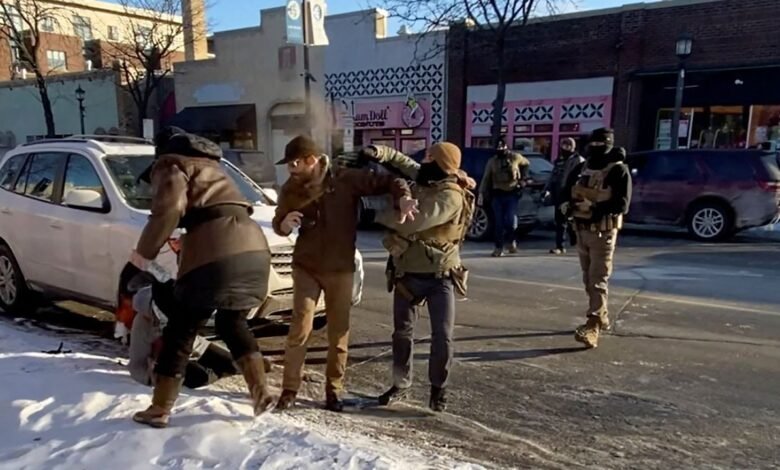
Before long, her angle hit the feed. Now anybody seeking the truth could plainly see that Pretti himself had been holding a smartphone camera, trying to make an honest document of events. One of the ICE agents—recognizable in what has become their uniform of choice: boots and loose pants and sweatshirts, shelled in olive-green bulletproof vests—had roughly pushed a woman to the ground. Pretti, attempting to help her up, had gotten a face full of pepper spray, then was dragged into the center of a circle of agents. One of the agents, discovering Pretti’s firearm—Minnesota is an open-carry state, provided you have a permit, which the Minneapolis police chief, Brian O’Hara, has said he did—takes it and ferries it away from the huddle. Soon another agent pulls out his own gun and starts the work of ending Pretti’s life. Just before he’s shot for the first time, Pretti still seems to be holding not a weapon, but his phone.
Almost every person I have spoken with over the past day can enumerate these details in minute and legalistic detail. In Pretti’s case and in Good’s, the proliferation of videos—of “angles”—has begun to blurrily expand what we mean by the words “witness” and “evidence.” People physically close to these brazen displays of brute, fatal force gather crucial seconds of visual proof, and then send them off, like messengers, into the digital world. Before long, all of us are pulled “close,” in a morbid, substitutionary way, to the site of disaster—closer than we’d like to be. It’s never been easier to paint and pass around a picture of a historic event.
The Trump Administration, still belligerently defensive of ICE’s operatives and authority, usually loves to play with pictures. They like to mess around with A.I. and turn its slop images into propaganda. They’ll turn Donald Trump into, say, the Pope, or J. D. Vance into a bearded guest star in the comic-strip world of “Dilbert.” Or they’ll employ the kitsch paintings of Thomas Kinkade to rewrite America as a glowing, homogenous, implicitly and eternally white place, situated in some placid pocket of the heart. Recently, the White House’s X account shared a distorted image of a Black woman named Nekima Levy Armstrong, who’d been arrested after protesting at a church in Minneapolis. In the doctored picture, she’s crying wildly. In reality, she stood with her hands cuffed behind her back, her face stoic. Maybe they figured that their supporters would love to see Levy like this: totally defeated, visibly abject after a quick scrape with the tough presence of the law.
But the existence of so many real and unvarnished images of Pretti’s killing posed a problem that Trump’s underlings have tried to patch up with words. Greg Bovino, the head of Border Patrol, claimed in an interview, on CNN Sunday morning, that Pretti had wanted to “massacre” law enforcement. “So, good job for our law enforcement in taking him down before he was able to do that,” he said. Kristi Noem, the Secretary of Homeland Security, declaimed that Pretti—manifestly nonviolent on the videos everybody has seen—was reacting “violently” in the moments before his death. Vance, who has become the Administration’s foremost spokesperson for justifying the deaths of innocents, reposted a picture of Pretti’s gun on X, coupling it with a plea for Minnesota’s political leadership to collaborate with ICE, so that “situations on the ground didn’t get out of hand.”
These were attempts at a kind of perverted art criticism, meant to offer ICE’s supporters a new way to parse the videos—a new “angle” on Pretti’s killing that could never be substantiated by their eyes. Our ability to participate in witnessing, to corroborate each other’s commonsense, to assure one another that, no, you are not crazy, they did just “fucking kill that guy,” is a threat to the Administration’s assumption of total power, not only over events but over how those events are interpreted and made into history. Their untroubled and automatic dishonesty, amid so much shared evidence, gives rise to a horrible question: If this is what they do when we can see, what’s going on in the places—planes and cars, detention centers—where we can’t? ♦